
The utility statement for your rented flats, done yourself
You enter the year’s costs and meter readings. The app splits everything between your tenants to the day, checks your entries and creates a letter for each tenant as a PDF. No account needed; your data stays on your device.
For iPhone, iPad, Mac and Android. Free up to the result on screen.

Once a year, and right first time
As a private landlord you prepare the utility statement (Nebenkostenabrechnung) once a year. By then you have forgotten how it went last time. Last year’s spreadsheet helps until a tenant moves out mid-year, a flat stands vacant for two months or heating costs have to be split by consumption. CO2 cost allocation has added yet another calculation.
Teilo does the arithmetic for you and asks for the details in the order you need them. Before there is a result, the app checks whether anything is missing or does not fit, and tells you in plain words what to do.
Who the app is for
A good fit if you
- let a few flats yourself, in your own building or as owner-occupied flats
- settle up once a year and do not want to forget anything
- do not want another account with an online service
- want to keep your data and your tenants’ data on your own device
- work on a phone, a tablet or a Mac
Probably not for you if you
- want to check rent payments through your bank account or keep accounts for your letting
- manage many units together with several people
- need a portal for your tenants
Online property management services with a wider scope are better suited for that.
How a statement works
On first start, the app explains the steps and which documents to have ready. To look around first, open an example house with made-up tenants. You set up your own property once. The app then takes you through every statement in seven steps. Every entry is saved straight away; you can stop at any time and carry on later.
Set up the property
Flats with their area, tenants with move-in date and advance payment. This applies to every year.
Billing period
Usually the calendar year. The app tells you the date by which the statement must reach the tenant.
Costs
Every bill with its type of cost and allocation key (Umlageschlüssel).
Heating costs
With central heating or district heating: share by consumption, hot water, CO2 details.
Meter readings
Start, end and, when tenants change, the interim reading. If a meter failed, you report it here.
Check
Errors, warnings and notes, each with one sentence on what to do and a button to the right step.
Result
Balance due or credit per tenant, the landlord’s share for vacancy.
Letter
One letter per tenant as a PDF, in German, suitable for window envelopes, with a new advance payment if you wish.
What it looks like
Screenshots of the app with the example house, which you can open in the app yourself. All names and figures are made up. The screenshots show the German interface; the app can be switched to English.
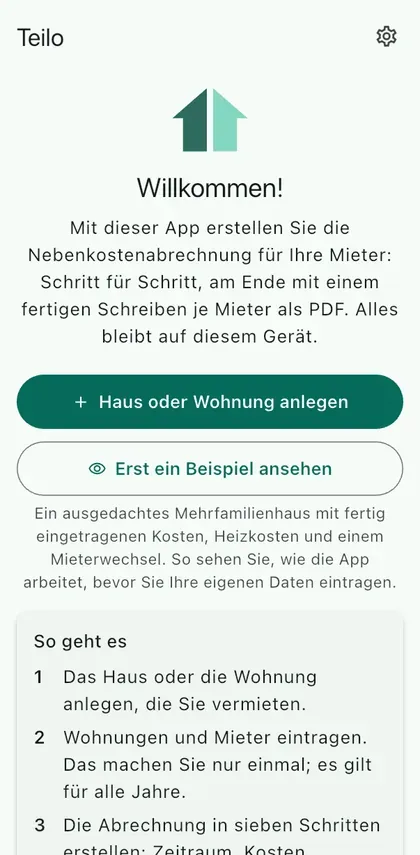
First startA short introduction and an example to look at. 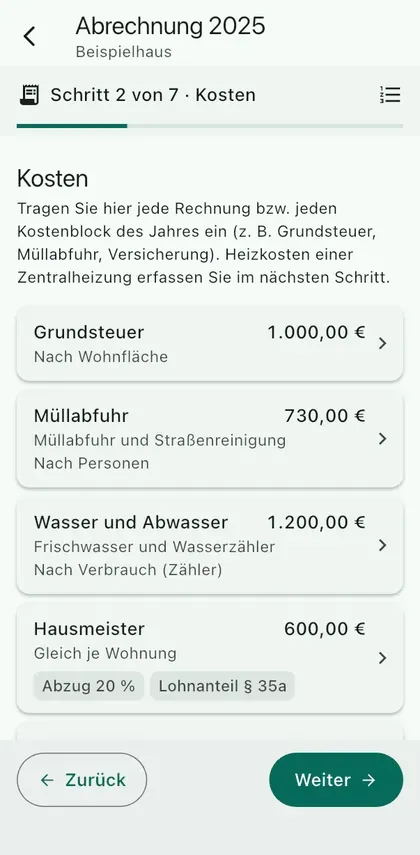
CostsEach item with amount and allocation key, special cases as a label. 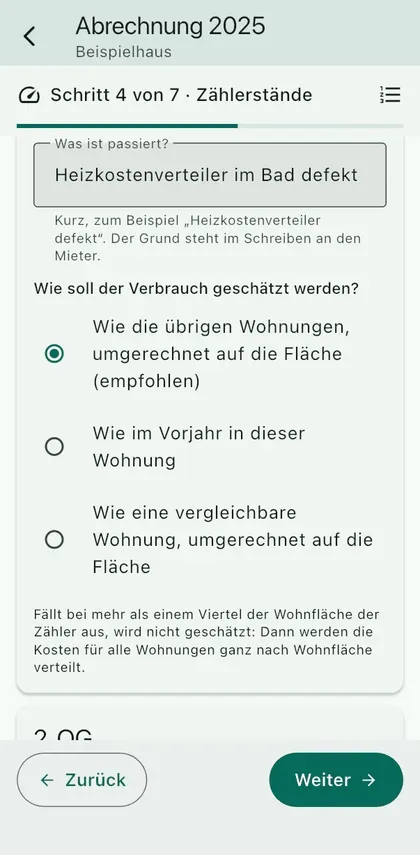
Meter failedEnter the reason, choose how to estimate. 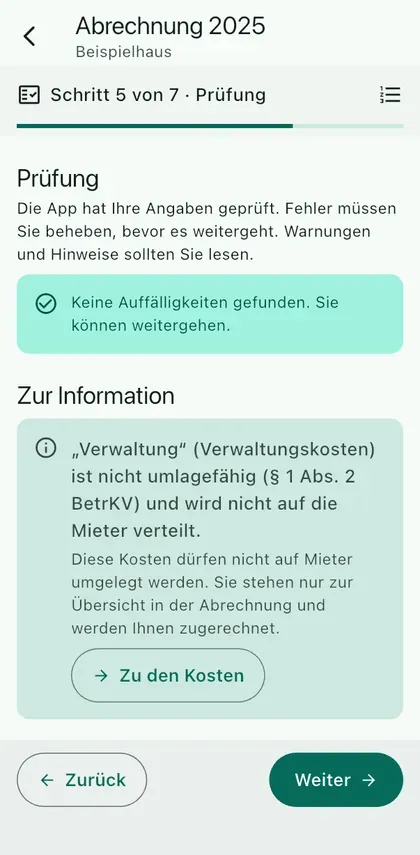
CheckWhat stands out, in plain words and with a way to fix it. 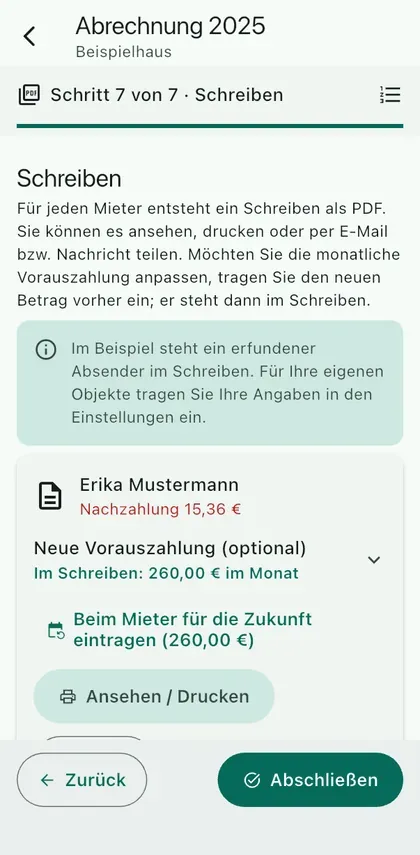
LetterOne PDF per tenant, with a new advance payment if you wish. 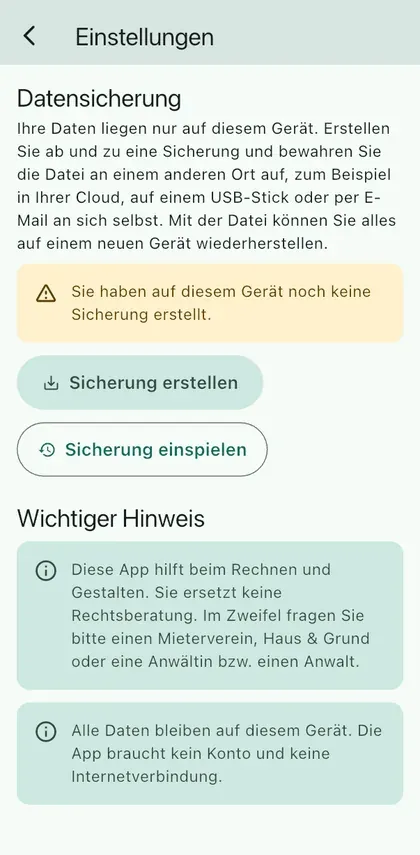
BackupA file that you keep yourself.


What the app does
Every allocation key
Living area, occupants, number of flats, metered consumption, co-ownership shares (Miteigentumsanteile) or assigned directly to one flat.
Change of tenant to the day
Moving in or out mid-year is calculated to the day. The app shows vacancy as the landlord’s share.
Heating costs under the HeizkV
50 to 70 % by consumption, the rest by area, as the Heating Costs Ordinance (Heizkostenverordnung, HeizkV) requires. With a shared system the app separates heating and hot water, or you enter both amounts from the metering service’s statement.
When a meter fails
The app determines consumption under § 9a HeizkV, from the other flats, the previous year or a comparable flat, and explains the estimate in the letter.
CO2 costs
Split between tenant and landlord under the tiered model, with classification and basis of calculation in the letter.
Information under § 6a HeizkV
Energy sources, charges, comparison with the previous year and with the average user appear in the letter, as far as you enter them.
§ 35a EStG
Labour costs for household services and tradesperson services are listed separately in the letter, for your tenants’ tax returns.
Reminder of the deadline
The overview shows by when the next statement must reach your tenants (§ 556 Abs. 3 BGB). If you like, your device reminds you eight, four and one week before, without a server.
Comparison with the previous year
The check shows each cost next to the previous year. Large jumps are marked so that a typing error stands out before you send anything.
Receipts for every item
Photograph an invoice or keep it as a PDF. For your tenants’ inspection of receipts there is a list of receipts as a PDF. The photos stay on your device.
Check before the result
Missing meter readings, costs not chargeable to tenants, an expired deadline: the app tells you before you send anything and takes you to the right step.
To the cent
The shares of all tenants and the landlord’s share add up exactly to the total costs. Not a cent is lost.
New advance payment
The app suggests a new monthly advance payment. Once accepted, it appears in the letter and can be entered for the tenant for the coming months.
Finalised stays finalised
If you later change tenants, areas or meter readings, finalised statements and their letters stay as they were.
Faster next year
Carry the statement over to the following year: cost items and allocation keys stay, you only enter the new amounts.
Backup
A backup file you keep yourself. It restores everything, even on a new device.
Large text, keyboard
The app follows your device’s text size. On Mac and iPad much can be done with the keyboard, with shortcuts for next, back and save.
Your data stays with you
The app needs no account and contains no tracking. It stores everything on your device and sends nothing.
What the app cannot do
No cloud sync, no bank connection, no tenant portal, no automatic reading of invoices (you keep receipts as a photo or PDF and enter amounts yourself). To move your data between two devices, use the backup file.
English app, German letter, German law
You can switch the app to English under Settings, Language. The letter to your tenants is always created in German. The calculation follows German law; amounts and dates are in German format (1.234,56 €, 31.12.2026) to match your bills and the letter.
Price
Try everything with your real figures before you pay anything. You only pay for the finished letters.
Free
0 €
no time limit
- everything up to the result on screen
- any number of properties
- check with all notes
- backup
- receipts, comparison with the previous year, deadline reminder
- the example house including its PDF
- PDF preview of your letters with a watermark
Annual subscription
14,99 €
per year
- everything in Free
- letters without a watermark for printing and sharing
One-time purchase
39,99 €
pay once
- everything in Free
- letters without a watermark for printing and sharing
Payment is handled by the App Store or Google Play.
Frequently asked questions
By when must the statement reach the tenant?
The statement must be communicated to the tenant no later than the end of the twelfth month after the end of the billing period. For the 2025 calendar year that is 31.12.2026. After that the landlord can no longer claim a balance due, unless the landlord is not responsible for the delay.
The app shows the date in the first step and warns you when the deadline has passed. Allow time for the post.
Legal source: § 556 Abs. 3 Satz 2 und 3 BGB
What do I need for the statement?
- the tenancy agreement: which costs are passed on and by which key
- all bills and notices for the year, for example property tax, water and sewage, waste collection, insurance, caretaker, gardening, electricity for the stairwell and outdoor lighting
- with central heating or district heating the fuel or heat bill, ideally with details of CO2 emissions and CO2 costs
- meter readings at the start and end of the period, and at move-out when tenants change
- living areas and, for allocation by occupants, the number of occupants
- move-in and move-out dates and the agreed monthly advance payments
- your bank details for balances due
Which costs can I pass on to tenants?
Tenants only bear operating costs (Betriebskosten) if the tenancy agreement says so. The Operating Costs Ordinance (Betriebskostenverordnung, BetrKV) lists which types of cost are operating costs in 17 items, from property tax to other operating costs. Management costs and the costs of maintenance and repair are not operating costs.
Legal source: § 556 Abs. 1 BGB, § 2 BetrKV, § 1 Abs. 2 BetrKV
Which key do I use to split the costs?
Unless your tenancy agreement says otherwise, operating costs are split by share of living area. Costs that depend on recorded consumption, such as water with meters in each flat, must be split by a key that reflects the different consumption. For a rented owner-occupied flat, unless otherwise agreed, the key used between the flat owners applies.
Legal source: § 556a Abs. 1 und 3 BGB
Do I have to split heating costs by consumption?
With a central heating system, at least 50 and at most 70 % of the costs must be split by recorded consumption, the rest by area. The same applies to central hot water. These rules take precedence over the tenancy agreement; buildings with no more than two flats, one of which the landlord lives in, are exempt.
If costs are not split by consumption contrary to the ordinance, the tenant may reduce their share by 15 % (Kürzungsrecht). The app tells you when meters or meter readings are missing.
Legal source: § 7 Abs. 1, § 8 Abs. 1, § 2 und § 12 Abs. 1 Satz 1 HeizkV
What do I do if a meter has failed?
If consumption cannot be recorded properly because a device failed or for other compelling reasons, it must be determined on a comparable basis: from consumption in comparable periods, from the consumption of comparable other rooms or from the average consumption of the building or user group. The determined value replaces the recorded one. If this affects more than 25 % of the area, the costs are split only by the keys for the other costs, usually by area.
In the app you report the failure at the meter readings step, enter the reason and choose how to estimate. The letter explains the estimate to the tenant.
Legal source: § 9a Abs. 1 und 2 HeizkV
How are CO2 costs split?
For residential buildings, the split depends on the building’s CO2 emissions per square metre of living area per year. Below 12 kg the tenant bears the CO2 costs alone; from 52 kg the landlord bears 95 %. In between, the landlord’s share rises in steps of 10 percentage points for every 5 kg.
In the heating cost statement the landlord must show the tenant’s share, the building’s classification and the basis of calculation. If this is missing, the tenant may reduce their share of the heating costs by 3 %.
Legal source: Anlage zu §§ 5 bis 7 CO2KostAufG, § 7 Abs. 3 und 4 CO2KostAufG
What is free, and what do I pay for?
Everything up to the result on screen is free, for any number of properties, as are backups and the example house including its PDF. For your own statements you see a PDF preview with a watermark. The full version provides the letters without a watermark for printing and sharing, as an annual subscription for 14,99 € or a one-time purchase for 39,99 €.
Where is my data stored?
Only on your device. There is no account and no server the app sends anything to. A letter only leaves your device when you share or print it yourself.
In Settings you create a backup file and keep it wherever you like, for example on a USB stick. It restores everything, even on a new device. There is no ongoing sync between several devices.
Does the app replace legal advice?
No. The calculation rules have been checked against the German statutory texts, nothing more. Your tenancy agreement may contain special terms the app does not know. For questions about a special case, a property owners’ association or a lawyer specialising in tenancy law can help.
Which devices does the app run on?
On iPhone, iPad and Mac as well as Android devices. On large screens you see the steps as a list next to your entries. The app follows your text size setting; on Mac and iPad you can also use the keyboard.
Please note: The answers restate the wording of the provisions cited in plain words (as of 10.11.2026). They are not legal advice. The legal sources are German law and are given in German.
Get your 2025 statement ready now
Download for free, enter your costs, see the result.